
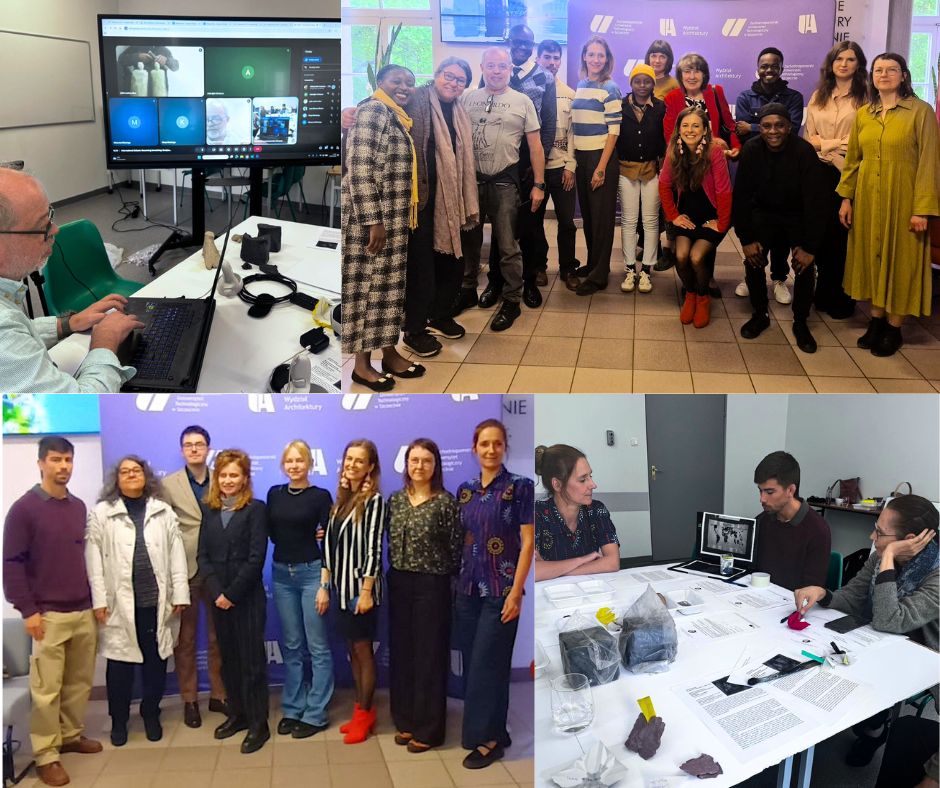
The Szczecin section of the CAPHE Horizon Europe MSCA SE Mobility 2026 focused on the intersections of technology, sculpture, architecture, cultural heritage, and immersive environments within the DIGITAL TWINS PANEL: Towards Technology and Digital Twins, organised through the collaboration of the Polish Society of Aesthetics (PTE) with Prof. Helena Elias and the Faculty of Fine Arts of the University of Lisbon (FBAUL) team and brought together artists, architects, designers, and researchers from Kenyatta University (KU), Jagiellonian University (UJ), Polish Society of Aesthetics (PTE), Faculty of Fine Arts of the University of Lisbon (FBAUL), Miastopracownia, The Mutuma Marangu Sculpture and Art Collection (TMMSAC©) and the West Pomeranian University of Technology in Szczecin (ZUT).

Participants of the Mobility in Szczecin | Photo by Aleksandra Łukaszewicz
The programme included workshops and discussions dedicated to parametric design, 3D scanning, cultural heritage engineering, hybrid opera, AR environments, and contemporary sculptural practice. A central moment of the programme was the international debate Becoming Something: Sculpture Between Materiality and Virtuality, exploring tensions between physicality and virtuality, craftsmanship and fine arts, and the changing ontological status of sculpture in computational environments.

Workshop “Sculptural Process as a Bridge Between Material and Digital Thinking” | Photo by Joanna Szczepanik

Workshop and Debate “Becoming Something: Sculpture between Materiality and Virtuality” | Photo by Helena Elias

Workshop and Debate “Becoming Something: Sculpture between Materiality and Virtuality” | Photo by Helena Elias

Workshop and Debate “Becoming Something: Sculpture between Materiality and Virtuality” | Photo by Helena Elias
Events also included a lecture by Miastopracownia on feminist architecture and digital tools, as well as seminars and soundwalks dedicated to, among others, the acoustic heritage and the theories of Raymond Murray Schafer, led by Prof. Małgorzata Szyszkowska, continuing the CAPHE project’s broader reflection on perception, embodiment and hybrid environments.

Lecture and Workshop by Miastopracownia “Architecture, Feminism, Digital Tools” | Photo by Joanna Szczepanik

CAPHE Participants of the Miastopracownia lecture | Photo by West Pomeranian University of Technology in Szczecin