
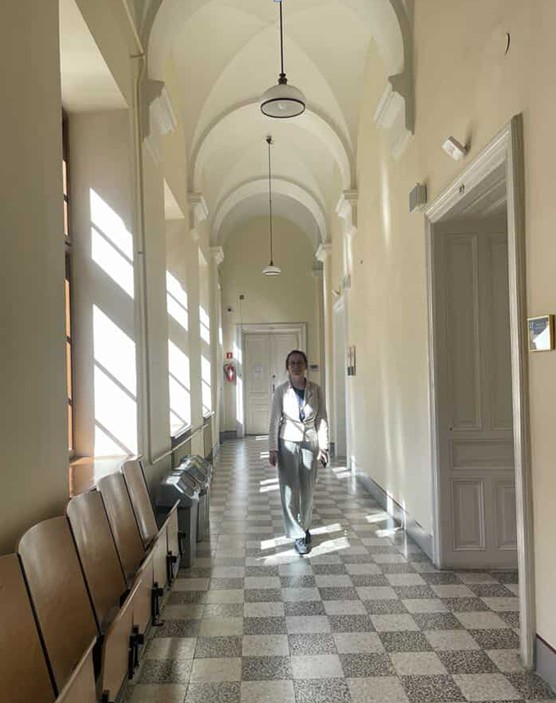
In collaboration and synergy with Miastopracownia, Dr. Ewa Chudoba – a philosopher, historian of women’s philosophy, CAPHE project manager, and a member of UJ partner – explores connections between architecture, feminism, and philosophy, focusing on how space shapes women’s experiences, knowledge production, and modes of participation. Below is one of her texts, which investigates these intersections, linking the analysis of a specific architectural setting with a broader feminist theoretical framework.
As a women’s philosophy historian (I wrote a monograph about Polish women philosophers at the Jagiellonian University 1897-1967 toghether with Anna Smywińska-Pohl – “Córki Nawojki”, Kraków 2017), who conducted research locally in Kraków with an emphasis on Jagiellonian University, and a close observer to always changing reality, I can conclude – from a perspective of CAPHE project’s advanced interactions and various mobilities – that space management (in years 2023-2026) in locations such us: Kraków, Nairobi, Florence, Lisbon, has little to offer to improve a quality of experiences for women. Kraków remained mostly unchanged in terms of public spaces for years. However, I have to admit that there are bicycles routes, cars access has been reduced significantly in the historical centre. Public squares, fountains, pavements, parks are free and fully available for all people, including women and children (this seems not to be the case in Africa). So mothers as well as other females can relax in public spaces safely and without limitations.
The Polish philosophers who worked in Collegium Broscianum during the 60s, 70s, 80s and 90s in the XXth century had very similar obstacles to today’s ones. As Collegium Broscianum is also a spot for CAPHE project I can regulary investigate its functionality. It is a very old historical building from the XVIIth century, who used to be a Jesuit convent, and later on was given to the Jagiellonian University and adapted to academic purposes accordingly. The building is cold, especially on the groundfloor, with poor air circulation and dangerous staircaces. Untfit for people with reduced mobility, even though an elevator was installed a decade ago. Always very uncomfortable. Various rennovations couldn’t uplift this unfortunate situation.
The Polish philosophers who worked and still work in the building can fully experience a patriarchal vertical building who was designed for male monks and Catholic God. It is located between two other churches: baroque Church of Saints Apostles Peter and Paul and Church of St. Joseph at Poselska Street which is operated by Bernardine Sisters. This specific location adds to the aura of Collegium Broscianum as a place out of this world and the least in service to women.
Having said that, it is worth mentioning that this unwelcome, heavy, pious sourroundings correspond greatly with characteristics of female experience in patriarchy, namely it gives an impression of alienation from the mainstream of male dominated culture (especially in the field of philosophy, which is lectured in Collegium Broscianum), being not heard neither understood, and being out-of-contex with female need for creating horizontal, interconnected, emotional lines of expression and rythmes during interacting with others.
One of the famous Polish philosopher who worked in this building was Maria Gołaszewska, who coined a modern theory of esthetic situation (M. Gołaszewska: I due poli dell’ estetica. “Revista di Estetica”, A. XII, Fasc. III, IX-XII 1967, and her main oeuvre “Zarys estetyki” Warszawa 1986). Her main idea was that such a situation is dynamic with an active participation of a human agent, both as a creator (artist) and recipient. Participation in art was according to her far from passive submission and standing in awe. Although she had never theorized about space as such (neither did female philosophers from my book) and its importance, she believed in open rythmical structures which are common in arts and esthetic experiences, and which somehow happen in space. Their value and stability depended not on stone, vertical shape and dignity but on adaptability, melleability and readiness to change.
Taking into consideration that some of her writings were done in Collegium Broscianium, I believe that she created her theory against its architecture and aura – also beacuse she was open to an empirical approach to esthetcis, which had been ahead of her times. So her functioning in this historical, postsecular building and at the same time writing innovative esthetic theories created a fault (in Polish “uskok”) – I was inspired to use this term by Polish literary scholar Marcin Czerwiński in his monograph about Polish female author Stanisława Przybyszewska, “Uskok. O Stanisławie Przybyszewskiej i innych”, Gdańsk 2023, page 324) between her modern texts and historical building of the former male convent. This lack of syntony, this combinantion of non-congruent elements is typical for women experience in Western society, culture, literature and philosophy – and can be in some instances very fruitful and dramatic at the same time.
Other women who lectured and wrote in this building were aomg others Izydora Dąmbska (there is a seminar room dedicated to her person), Danuta Gierulanka, Janina Makota, Beata Szymańska-Aleksandrowicz, Halina Poświatowska (also a legendary poet), Ewa Żarnecka-Biały, Zdzisława Piątek, Elżbieta Paczkowska-Łagowska.
Ewa Chudoba in the corridor of Collegium Broscianum (former Jesuit convent), Jagiellonian University, Kraków. Photo: Karina Jarzyńska, 2025